Blog

Skunks Around The Barn Are Trouble

At one time, I actually managed a self-service barn.  It wasn’t very large, just 10 stalls, a large tack/feed room, riding arena & about a 5 acre pasture.  This property was one of several that was at end of the flight path to my town’s airport.    The largest of the properties was about a 30 acre pasture.  This made a significant greenbelt region in town.

The wildlife varied.  In the spring & fall, there were the migrating birds that landed looking for food in the Skunks hanging around the barn are a nuisance & a possible threat to your horse's healthpasture.  There was even a red fox that showed up but never stopped.  It made its hurried travel through the pasture to get to cover in the next property.  There were the urban possums & rabbits.  You could catch a glimpse of an occasional owl at dusk in the fall.  The one critter that seemed to make it’s home somewhere near (or under) the buildings was a skunk.
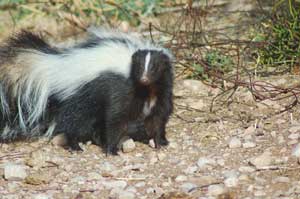
I was running late to feed Iggette one night.  I turned on the light in the feed room and there I was, having a stare contest with a skunk.  I almost killed myself backing out of the feed room before it decided to spray everything in sight.  When safely on the other side of the doorway, I noticed that the skunk was not concerned with my presence.  It was merrily eating the cat food that someone had left for the barn cats.  I waited until the skunk had it’s fill and waddled back under the hay & out of sight.

For the next few weeks, the skunk & I came to an understanding.  I had put my lunge whip next to the door.  When I turned on the light & if the skunk was there eating, I tapped it on the back with the whip.  It would look at me and then move under the hay.  Fortunately, it wasn’t my hay so I could do what I needed to do in the feed room.  Each time I left, it would reappear to eat.  Each time I would come back, I would tap it on the back and it would move back under the hay.  The amazing point is it never offered to spray me or the room.  It was never aggressive.

One night, my husband came with me.  I was behind him when he turned on the the light to the feed.  I don’t think I ever saw anyone move as fast as he did getting out that room.  He bumped into me, almost knocking me down.  I thought he had seen a snake or wasp or something like that.  My husband is irrationally wary of wasps, hornets, etc because of an unfortunate encounter with hornets as a young boy.  I asked him what was the matter.  He looked at me & replied “SKUNK!”  I told him I knew there was a skunk.  I told him to move and reached for my whip.  By now, the skunk knew the routine and just moved back without being tapped.  It stayed put until I was out of the feed room and then moved back to the food.  My husband was utterly amazed at our strange routine, but he didn’t offer to help with anything that was inside.

This strange relationship went on into the winter.  Then the skunk disappeared as suddenly as it had appeared.  I never saw it again.

With humankind ever encroaching on nature, some wildlife is adapting to urban ways.  This incident gave me cause to do some research.  Wild skunks usually stay away from humans.  Skunks can carry rabies.

Where am I going with this?  I highly encourage vaccinating your horse for rabies as part of your annual shots.  I started giving my horse a rabies shot shortly after the skunk moved in.  I continue giving my horses a rabies shot every year.  I have persuaded most of my friends to give rabies shots to their horses, whether they board in town or have a place in the country.

You protect your dog & cat from rabies.  Why not protect your horse.

As always, don’t forget to let me know what YOU think.

Inspect The Barn For Your Horse’s Safety

I went to a seminar recently put on by my vet.  We were introduced to the 2 new vets that had just joined the team.  We were also reacquainted to the team that is behind the scenes; the office help, the vet techs who Loose fencing is a hazard to your horseaccompany each vet on calls and the barn manager who looks after your horse if he needs to stay for more intensive care.  I really appreciate each & every one of these people.  They do a great job.  A presentation was done by each of the 2 new vets.  One was on the importance of proper wound care.  I could go on for days about this subject because my horses have given me plenty of practice.  But I would like to talk about how you can possibly prevent some injuries.
Lord knows, both Iggette & Zip had their share of injuries.

Iggette had one injury to the left hind leg caused by a loose fence. The wire was down in one spot of her pasture and tangled in some weeds.  This happened all too soon after I purchased her.  Doctoring a leg & changing dressings is not what I envisioned for my bonding experience with my first horse.

A few years later, she caught her shoulder on an exposed nail head in the gate post.

Iggette also injured her front feet from pawing at the fence & getting caught on the barbed wire.  Each time this happened (twice on each leg), Iggette found herself in the stall with a cast for weeks while recovering.  I don’t know who disliked stall rest worse, Iggette or me.  Iggette NEVER liked being in a stall.  She walked circles the entire time she was confined.  This meant  ground in manure which was next to impossible to pick out.  It was just easier to strip it & start over with clean bedding.

Zip had a puncture wound to a hind pastern.  The vet said I was real lucky it didn’t cut a tendon.  Then just a few months later, she sliced herself on the under side of the jaw line.  This took about 30 stitches to close.  The cause of these 2 injuries were never found by either my trainer or myself.  We Dispose of any flood debris left in your pasturelooked for hours & did not find a spot of blood or the tell tale sign of horse hair on a fence post or tree branch.  Zip’s injuries were costly & required weeks of stall rest to heal.
With colder weather just around the corner, your horse may start spending more time in the stall.  You can prevent some injuries by just being observant of their surroundings.  Take time to really look over your horse’s stall, barn & pasture whether you own your barn or you are boarding.

Over the years, I’ve learned what to look for to make sure my horse’s environment is relatively safe.  I’ve listed a few of the things to look for below.

BARN & STALLS:

  • Hammer down any nails that have backed out of the wood.
  • Look for any loose or broken boards in the walls that need to be replaced.
  • Check the stall doors & latches to make sure they are working properly and the hardware is securely in place.
  • Make sure the bucket hangers are in good shape.  You don’t want to find your horse with the bucket as his hat or using it as a kick ball.
  • Keep the aisle clear of clutter.  A loose frightened horse and a cluttered aisle way are not a good combination.
  • Make sure the tack room & especially the feed room have a good lock on the door.  You don’t want your baby helping himself to a midnight snack.  An open feed room to a horse is like turning a kid loose in a candy store.  They just don’t know when to quit and more importantly . .  they won’t.
  • Check the fence charger to make sure it is working properly.
  • Check the electrical wiring for damage to the insulation.  Rodents (rats, mice & squirrels) will chew thru wires.  While most wiring is not in the reach of horses, frayed wires can be a fire hazard.
  • Check for leaks in the roof while it’s raining and mark them for repair on a dry day.  You really don’t want rain in the feed/tack room or over your hay storage area.

 
FENCES:

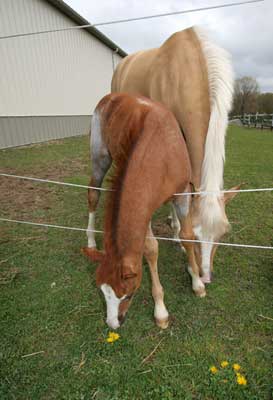
  • Walk the fence line of both paddocks & pastures to look for loose wire.  Look at the posts to make sure the wire is actually attached and not just hanging somewhere near it.
  • Make sure the gates are hanging properly.
  • Check for broken planks on board fences or broken fence posts.
  • If you have an electric fence, make sure the insulators are all in place and that the wire is not shorting out.  I had a little paint mare that would actually touch the electric fence everyday just to see if it was working.  If it was off, she would poke her head through the fence to get the grass on the other side.


PASTURES

  • Keep the trash picked up.  This goes for the barn also.  Blowing trash to some horses is the absolute most terrifying monster there ever was; even if the piece of trash is just a small candy wrapper.
  • Make sure to mow as necessary to keep the weeds down.  Tall pasture grass/weeds can hide a lot of potenial hazards.
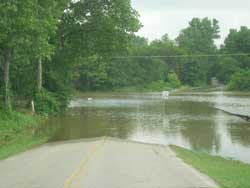
  • If you have had really bad weather (heavy snow, ice, high winds, floods etc), check any trees on the property for damaged branches.  Dead branches falling from the trees can happen months after it was damaged.
  • Remove as much of the debris as possible.  Any debris that is allowed to stack up in the pasture can become the home for unwanted animals & reptiles.  This is a whole other type of hazard to your horse.

If you are boarding your horse, let the owner/mananger know of anything you find that is in need of repair.  You could even offer to help with some of the minor repairs.  If you own your place, fix the minor things as they are discovered and schedule a weekend to tackle the bigger repairs.  The sooner repairs are done, the safer the environment is for your horse.

In my opinion . . . . . It’s not if a horse will get hurt . . . . it’s just when and how bad.  Protect your baby, and your wallet, as best you can by just being observant.


Trailer Training Is Not A Last Minute Task

Dollar is my 6 year old palomino gelding.  I named him after the horse John Wayne rode in his movies.  Never mind that the movie Dollar was a sorrel, I am just one of those avid “Duke” movie fans.  Anyway, Dollar is just about as laid back as a horse can get.  I haven’t found anything that bothers him.  He also has as much curiosity as any cat.  He’s always looking to see what you are doing and at times it seems like he would really rather help you with whatever it is you’re doing.  He’ll walk along side of the tractor while the pasture is being mowed looking like he’s trying to tell you how to drive & mow.  He stands guard by a ladder while you are on the roof.  He also likes to floss his teeth with the tail of the lead rope you have him tied with.
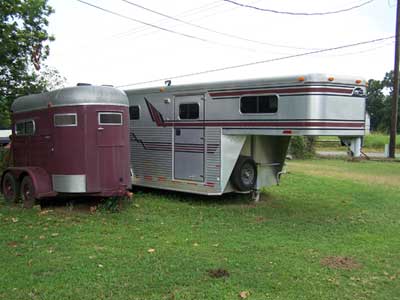
Dollar has had his moments where he didn’t want to load in a trailer.  I have had to do last minute trailer training while trying to go to a show.  I have also had him refuse to load in the trailer when trying to leave the show.  Almost all horses at one time in their lives will be difficult to load in a trailer.  But consistent training and practice rides have helped immensely.  He now just walks into a trailer like an old pro.

My trainer, Ellen, told me she had to use Dollar this last weekend.  One of the other horses (let’s call him Teddy) at the barn had been sold and was leaving.  The new owner could not get Teddy to load in the slant load trailer.  Teddy is just a big kid (about 16.5h) and really had little training.  He stopped at the trailer door and refused to budge.  The new owner decided some trailer training was going to be necessary before leaving.  After several failed attempts, Ellen offered to get Dollar out of the pasture.  Dollar was Teddy’s “pasture and play mate”.  Dollar was loaded first and then Teddy was led up to the trailer.  He was quite reluctant to load.  He did get his front feet in the trailer and immediately backed right out.  He did this a few times, each time inching further in the trailer.  Finally, Teddy stepped all the way in and stood nervously beside Dollar.  Ellen told the new owner to just let them chill there for awhile, so Teddy would become adjusted to the trailer.  Then both were unloaded so Teddy could be loaded by himself.   Next Dollar was tied to the outside of the trailer as an enticement for Teddy to load.  It took a while, but Teddy was finally coaxed back in the trailer.  Ellen took Dollar back to the pasture.  Before she walked back to the barn, there was Teddy standing at the gate ready to go back to the pasture.  The new owner told Ellen that Teddy had managed to get his head over the divider bar and his neck was caught between the trailer wall and the divider.  He couldn’t get loose by himself.  To keep him from becoming terrified, he was freed from his precarious predicament and he immediately escaped from the trailer.

Well now, you can just imagine how hard it was going to be to get Teddy back in the trailer this time.  No amount of coaxing or bribing with his favorite treat seemed to work.  So it was back from the pasture for Dollar.  This time, tying Dollar outside the trailer did absolutely no good.  Since Teddy was wise to this trickery, Ellen decided it was time to actually load Dollar in the trailer again.  By this time, Dollar was a little tired of the this game also.  He balked.   But after being walked around in a circle, he loaded right in.  Teddy took some convincing.  He was  convinced by 2 people locking arms behind his haunches & helping him in the trailer.   Ellen told the new owner to tie Teddy in the trailer.  This way he wouldn’t escape again.

Now, how to get Dollar out of the trailer.  The new owner offered to let Teddy out so Dollar could be unloaded.  Ellen graciously declined this offer because it had taken literally 3 hours to get Teddy to this point.  Spending another 3 hours loading this big baby was not what Ellen had imagined for her afternoon.  She said she would get him out through the escape door.  She threw the lead rope over Dollar’s back, opened the escape door and called for him.  She had placed the bucket with the remaining food about 3 strides away from the trailer.  Dollar looked at the food and started out.  He then saw the ground which was a very long drop.  He backed up, looked at the grain and Ellen called him again.  Dollar once again stepped towards the escape door, once again looked at the ground.  Then he stepped forward enough to get both feet on the ground.  He never balked after that and just stepped right out the door and walked over to the bucket that held his treat.  The new and old owners just looked in amazement.  All Ellen said was “He’s not for sale” , turned and walked Dollar back to the pasture.

The point of this story is not about the loading/unloading methods (through the escape door) that were used on Dollar.  Neither Ellen nor I advocate this method used for anyone!  It was used because we both know the temperament of Dollar and knew his trailering abilities.  Please do not try this with your horse.  So what is the point of this story?  If your are selling a horse, be honest about the experience your horse has with trailering.  If you are buying, ask to see the horse load in trailer and maybe even take a small trip to see how the horse rides.  If you are going to a show, trail ride or even just to the vet, don’t wait until you need to leave before you trailer train your horse.  All you’ll get is frustrated with your horse and your horse will probably develop a very negative attitude towards trailering.  Take the time to trailer train your horse properly and take him on small trips every now & then to reinforce the training.  Nothing takes the place of preparing you and your horse for anything, whether it be riding or trailering.

How do I know this . . . don’t ask!

Leave a comment & tell us one of your horse trailer stories.


Attitude Is Everything

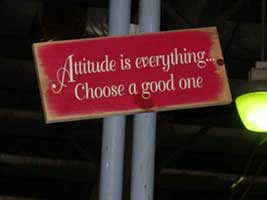
Attitude Is Everything . . Choose A Good One

This plaque was hanging at the entrance to the holding pen for a horse show.  Every exhibitor walked or rode past it every time they entered for their next class.  Most acknowledged the importance of the message. 

To me, this means I should have a winning attitude.  Knowing I have done my best to prepare both me and my horse, I come out a winner even if I don’t place in class.  I treat my horse with the respect that he deserves.  I take responsiblity for the mistakes that are made.  I don’t blame my horse for every missed cue.  I try to ride with a gentle hand, a quiet leg and a soft seat.  I’ve found that this gets better results even if my horse is having a bad day.  I try to be polite, courteous and pleasant to all around me.  Good manners should not be lost in the horse world.  I arrive a little early.  I offer my help if needed.  Finally, I have fun!

 Attitude Is Everything . . Choose A Good One

What does this mean to you?  I encourage you to leave a comment. 


Volunteer For a Horse Show

Mike is a longtime volunteer for PHBA The Palomino World Show finished up it’s week long run.  As always, it was a very good show.  This is about my 20th year to volunteer for this show.  When I started volunteering for this show, I didn’t even own a palomino.  I didn’t purchase my first palomino until 2002.  I volunteer for this show because I absolutely love doing it.  I take a week vacation from my job to volunteer.  I get to see some old friends that I have made over the years and I always meet new ones.   
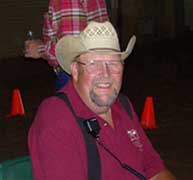
I started volunteering for small club horse shows back in the 80s just after I purchased Iggette.  I really didn’t know what I was doing, but I had a blast.  I’ve done everything from being a gate person to ring steward.  One year, a friend asked if I would help with the Palomino World.  This was to help check the markings of each horse against their registration papers.  I didn’t really know what I was getting myself into. Les comes from Iowa to volunteer every year The show then was only 3 very long days.  I learned to read fast and on the run.  The show has grown over the past 20 years to the 7 day show it is today.  I still have to speed read and do it on the run.  Some things never change.   
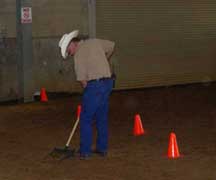
If you have some spare time, consider volunteering for a horse show in your area.  You don’t have to own the breed of horse of any show that you’d like to help.  You just have to have the desire to help.  The different clubs & associations are always in need of volunteers.   Some of the jobs that are usually filled by volunteers are being a gate person (both in and out since these are usually different), checking in exhibitors for classes, ring steward, stalling, or just being a runner.  Keeping the area clean is also a big job.  Volunteering for a horse show can be very demanding work.  The hours can be long & at times can be very hectic.  You have to be versatile because you may be asked to take over another person’s job.

Volunteering sometimes has double dutiesIf you DO decide to volunteer, some things to remember are to always be pleasant & courteous to both exhibitors and staff.  You may be a volunteer, but you are one of the many faces for the organization putting on the show.  Help out for any job that is needed.  If you are not sure of the duties, ask one of the staff members for some guidance before the show starts.  If there is a problem, ask one of the staff members of the organization to help.  Don’t take longer for meals than any other staff member.  Don’t be in the wrong place or take a job that was not assigned to you.  Be prepared by bringing your own pen, water bottle and possibly small snacks.  There may not always be time to run to the water fountain.  Unless you are instructed to wear specific clothes, dress comfortably.  Don’t wear boots that pinch your toes or sandals.  You are probably going to be on your feet and on the move all day long.  At the end of the show, turn in any equipment that you were given.  Also before you leave the show, make sure you check in with a staff member.  They will appreciate knowing that you are no longer on duty.
It takes MANY volunteers to help put on a horse show.  Volunteers can be be from the local club putting on the show or it could be you.  Volunteer for a horse show in your area.  I’ll bet you’ll have fun!


Come See The Palomino Youth World Show

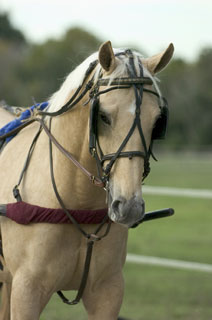
Palomino Horse in Driving RigThe Palomino Youth World Show is now in full swing.  If you live in the Tulsa Oklahoma area, THIS IS A MUST SEE!!!!  No where else can you see so many beautiful golden horses in one place.  No where else can you see so many different variations of the golden horse.  Whether you like trail, English, Western or Halter, there is a class that will catch your attention.  Come out to the Tulsa fairgrounds and see the kids guide these horses around the arena and put them through their paces.  Go to www.palominohba.com for a tentative show schedule.
There’s no excuse, it’s free admission!


The Effect of the Economy on My Horses

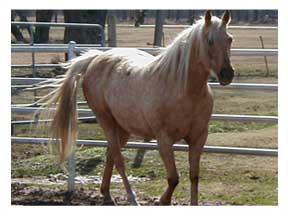
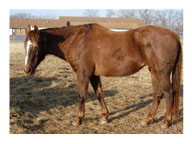
a good horse for the noviceThe floundering economy has touched the horse industry in so many ways.  My own personal concession is I had to sell one of my horses.  I did this last November (before Iggette passed) to try to cut the rising cost of my board bill as well as the vet bill.  I didn’t want to sell Princess (pictured) and it was a hard decsison to make.  Actually I was supposed to sell one when I purchased my gelding over 2 years ago.  I just didn’t ever get around to it.  Quite honestly if we lived on our acreage instead of in town, I wouldn’t have sold her.  But she has a very nice owner who decided to stay at the barn where I am, so I get to see her all the time.  After Iggette passed away, I was left with 2 horses.  Even with my board bill being reduced by 2 horses, the money crunch can still be felt.  I have made some small adjustments in my horse keeping to save some money.  Here are a few of the ways that I chosen to save money.  Please keep in mind that my choices may not work for you.  Make your decisions wisely.
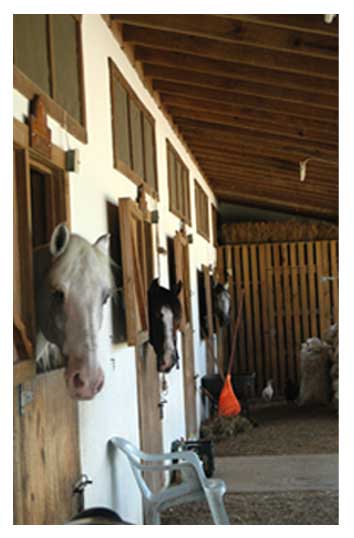
1.  My boarding has fluctuated over the years.  For 4 horses, I changed all of them to pasture board only.   After selling Princess & Iggette’s death, I changed my board to pasture with stall rights for inclement weather.  This is cheaper than full board in a stall.  Not all barns offer this option, but a good choice might be a paddock with a run-in shed.

2.  My horses are school horses.  I receive a small payment each time one of them is used for a lesson.  This pays my farrier bill most of the time.  There are times when it’s been too cold or too wet to have lessons.  On those times, I have to supplement the difference from my pocket.

3.  Since I don’t actively show or ride the trails, I have my farrier trim my horses hooves.  I am lucky to have horses that have good feet and  I’m a big believer in barefoot is better.  Trimming costs less than shoeing your horse.  This is a truly personal choice.  You, with the help of your farrier & your vet, have to make your decision based on your horse’s needs.

4.  I worm my horses myself.  I use a paste wormer and shop around for sales.  Sometimes I buy from the catalogs or on-line and sometimes I buy from the local co-op.  When buying from the catalog or on-line, be sure to compare the cost + shipping versus the cost + local sales tax.  You may be suprised how close these can turn out to be.  Try to find free shipping specials.

5.  I give my own shots.  I have bought shots from both the local co-op & from my vet.  If you don’t use the vet, make sure to tell his office what vaccinations you have given your horse.  This is to keep your records up to date.  I do not recommend this for the true novice.  You need to be trained on how to give shots.  Next time the vet is out, ask him to show you.  Also, check to see what shots are recommended for your particular area.

6.  If you have a trailer, haul your horse to the vet whenever possible.  This saves the farm call.  With the ever increasing fuel costs, the farm call fee is only going to go up.  Keep in mind that some vets also charge a mileage fee as well as the farm call fee.

7. I have owned mares for years.  I also don’t breed my mares.  I don’t have the added costs of  a pregnant mare or the cost of trying to raise a foal.  There are just wwwaaayyyyyy to many horses out there to consider breeding for one.  I can always find a good horse.

There are lots of ways you can cut your horse keeping costs.  The one thing to remember is to keep your horse’s well being in mind.


Secure Those Stall Doors

Even though Iggette is gone now, she still has lessons to teach.    Let’s talk about securing the stall door & gates.  Most people look at the latch on any typical stall and wonder how in the world can a horse open it.  Well let me tell you, Iggette was quite an escape artist.  She learned this little feat while at the first stable and continued it at other stables.

The small pasture I originally put Iggette in just didn’t work out as planned.  She was the only horse there and horses just don’t fair well by themselves.  So I moved her to a shed row with 3 large paddocks and each paddock was shared by 4 stalls.  Everyone who had stalls here rotated paddock time.  Iggette had other horses to visit and a mare next to her.  I felt like I had her in a pretty safe place.  The stall was big, it was in good condition, the stall door was a partial door so that she could stick her head out and socialize and the paddock was secure.  The stall & paddock gate had “horse-proof” latches, so I knew she would be safe.

I’m one of those anal types when it comes to checking & rechecking for closed & locked doors.  When I left everyday, I must have checked the stall door 5 times, the feed room door 10 times and the paddock gate 20 times.  I absolutely wanted to make sure that my horse came to no harm through my carelessness.  Can you imagine the shock I felt one day when one of my friends called me at work to say my horse was out.  Not just out of her stall, not out of the paddock, but out in the open field!!!!  This field had no fence and it was only a few yards from a busy street.  I rushed from worked to the stable.  As I drove up the long driveway, I saw my friend out in the pasture trying to coax Iggette AND her friend to come to her.  I went to the tack room and got a bucket of grain.  If Iggette was anything, she was a chow hound.  I just knew she would come to me with this temptation.  To my surprise, Iggette thought much more of her freedom at the time than what her belly would normally tell her.  Everytime I got near her, she would turn tail & sprint off in the opposite direction.  Remember I told she was hard to catch and she was certainly living up to that on this day.

I talked with my friend while trying to catch up with these two.  She told me she didn’t know how they got out.  She came out to feed her horse which was in the paddock next to mine.  She noticed that my horse was not anywhere to be found.  She looked for her and just happened to catch a glimpse of her through an alleyway between our shedrow and the one behind us.  That’s when she called me.  Since we weren’t having much luck trying to catch them, we changed out tactics.  We decided to try to herd them into a semi-enclosed area.  There at least, we might have a chance putting a halter on them.  Funny how things work out.  Iggette led us right into the alleyway and actually caught herself.  I was quick to put a halter on her and my friend caught the other horse.

I put my horse back in her stall.  The other horse, we just left out in the paddock since it was her time to be out.  Iggette had another idea.  I was standing not far from the stall talking with my friend, all of a sudden Iggette’s stall door flew open.  Iggette promptly walked out and went over to her mare friend.  She actually herded the mare back into her stall & closed the door on her.  She didn’t lock, just pushed it shut.  Then she returned to her stall and closed her door.  My jaw just about hit the dirt.  My friend & I looked at each other in total amazement.  How did she do that?!

It was time for a little investigative work.  I locked Iggette’s door and all of the others in our paddock area.  In no time, Igggette’s head popped over the door and started jiggling the latch with her lip.  You’ve seen how a horse will curl their lip when you scratch just the right spot, well that’s what her lip looked like.  It was only about 30 seconds later and she was out of her stall.  She went next door and got her lip working over that latch.  Soon, her friend was out and they both went over to the gate.  Iggette once again got the lip going.  Fortunately for us, I had figured out where she was going and just got to the gate before it too went flying open.

An escape artist had been born.  Now the hard part was going to figure out how to keep Iggette in her stall and keep her safe.  We start with making sure the “horse-proof” latches have a way to lock it closed.  Get a swivel snap or double ended snap & secure the stall door latch.  A simple $2 piece of hardware can give you piece of mind.  It may be more of a pain to the open the stall door, but wouldn’t you rather have a friendly face meeting you at the stall instead of you meeting your worst fears opening an empty stall?


In Loving Memory


  Juniper Moon Wind
Affectionately Known As Iggette

 April 6, 1977 To March 20, 2008

 She Was An Outstanding Horse For Many Years

 She Will Be Greatly Missed
By All Who She Taught to Ride
& By Those Who She Helped Overcome Their Fears


Meet My First Horse

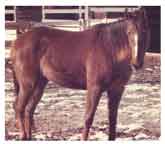
My first horse Igette was a race bred quarter horse

I’ve been referring to my first horse in several posts.  Let me introduce you to Juniper Moon Wind, affectionately called Iggette.  If you’ve read my posts on what & what not to look for, this is a very good lesson in what NOT to do for your first horse.  Iggette, in her younger days, was an absolute nightmare for any novice.  I will add that in time with a lot of patience & training, she became the best horse ever for both me and the countless students that she taught how to ride and overcome their fears.

Iggette is a race bred Quarter horse.  In 1979, she was in training at a smaller track in my area.  She had about 60 or 90 days of training.  To be quite honest, I just don’t remember anymore.  As with a lot of young race horses, her legs just couldn’t stand up to the strain of hard training.  Before she ever had an official race, she hurt her front legs.  This wasn’t a life threatening injury, but it did end her race career.  The only good therapy was complete rest.

Iggette was taken off the track to recover at her owner’s home.  She was put in a pasture with feeder cows.  Unfortunately for Iggette, she has a lot more cow sense in her that a race horse should have.  She herded the cows around the pen, cut them into corners and wouldn’t let eat.  She did this several times a day.  Let’s just say she wouldn’t let the cows fatten up and a skinny cow is not what you want to take to the butcher.  To top this off, Iggette bucked off the owner’s wife when she was ridden.  Remember Iggette only had race training, she didn’t know how to be a pleasure riding horse.  This just added insult to injury.  It was time to sell her.

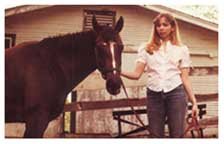
My and Igge at CavalierThis is where I come in.  I had never owned a horse, I had never taken care of a horse and I had only ridden a few backyard pets that my friends had.  I was a stupid 20 something and was just as horse crazy then as when I was at 4.  Oh yeah, I was also recuperating from a very bad fall off a lesson horse trying to learn how to jump fences.  I was told Iggette was going to the sale barn and I just couldn’t let that happen.  I talked my husband into buying her.  I wasn’t sure what I was going to do with her, but I knew I couldn’t let her go to the sale where she might end up in the hands of the killers.  I bought her without even going to look at her first.  This is how I became a novice owner.


When I went to get her, her former owner had offered to trailer her for me since I had neither a truck or trailer.  Being off the track, I thought she would just jump in the trailer & off we’d go.  We tried loading her the normal way by just walking into the trailer, she won that battle.  We tried a rope around her backside to try to pull her in, she won that battle.  We tried backing the trailer in the ditch so she wouldn’t have very far to step up, she won that battle.  We finally had to put her in a stall and back the trailer up to the door.  After an hour of trying to coax her in, we won – sort of.  She did get in the trailer, but she did the 4-foot shuffle all the way to her new home.  Whew, was I glad that was over.

Iggette’s new home was a stable not far from my house.  I did the good owner thing and walked her around the pasture so that she would know the fenceline.  Just as I took off her halter, a jet flew overhead as it was taking off from the airport.  The airport was less than a 1/4 mile from the stable.  Needless to say it was low and loud.  Iggette reared up at the sound of very loud jet engines & took off running.  She had never heard this sound before & it scared the daylights out of her.  I couldn’t catch her the rest of the day.  Within a week, jets didn’t phase her anymore.  Catching her while in the pasture remained one of her biggest vices for quite a few years though.

As for riding her, I quickly learned race training is just what it implies.  The only gaits she knew how to do were a fidgety walk and run at top speed.  I needed help and decided to use the resident manager/trainer.  This was another big mistake.  ALWAYS – ALWAYS – ALWAYS check out the trainer before hand.  Talk with some of their customers, watch a few of their training sessions and talk with other people in their barn.  If the trainer discourages or flat out won’t let you talk to their clients or watch them train, pass them up.  Don’t even think about it.  After finding out a few of his “training techniques”, I knew this was definitely not the trainer for me or my new horse.

I suffered through trying to train her myself or maybe it was Iggette who suffered through a complete novice trying to train a green horse.  We didn’t get very far.  Since I had no idea of what I was doing, the best I could manage was a somewhat slower walk and a trot that would jar your teeth out.  I didn’t try to lope at this point.  To be quite honest, I was intimidated and she knew it.  She never tried to dump me or rub me off on the nearest fence, but she was never willing to give to in to me either.  She seemed to do better with women than with men.  My husband would ride her and she would do little bunny hops sideways.

So to sum up this part of my novice experience: I bought a 3 yr old horse. I bought a horse off the racetrack. I bought a horse that only had race training and no other type of training. I bought a horse I had never even seen. I bought a horse from sheer emotion. I bought a horse that at times was almost impossible to catch. I bought a horse that would not load in a trailer.

How many more wrong things can a person do?

You can see now why I am passionate about helping other novice horsemen out there.  It can be mighty painful without some experienced help.